Quick answer
If your headlights and dash stay bright but the engine only clicks and won't crank, the battery still has some charge but not enough cold cranking amps to turn the starter — or a loose, corroded, or burnt battery cable is choking the current. Rapid, repeated clicking almost always means a weak battery or bad terminal connection; a single solid click points to the starter or its solenoid. Try a jump-start first: if it cranks and starts, the battery or charging system is the culprit (clean the terminals before assuming the battery is dead).
Common causes
- A weak or aging battery that reads about 12 V at rest but collapses under cranking load — it can still run lights and the radio because they draw only a few amps, while the starter needs hundreds
- Loose, corroded, or burnt battery terminals and cable clamps that pass enough voltage for accessories but can't carry the high cranking current
- A bad or frayed ground cable between the battery negative post, chassis, and engine block, starving the starter of a return path
- A failing starter motor or starter solenoid that produces a single loud click when it engages but can't spin the engine
- An alternator that isn't charging, leaving the battery to slowly run down until it can crank no longer — a jump-start works but the car dies again shortly after
- A parasitic drain (a light, module, or aftermarket accessory left on) that depleted the battery overnight so it has charge for lights but not for cranking
How to diagnose it
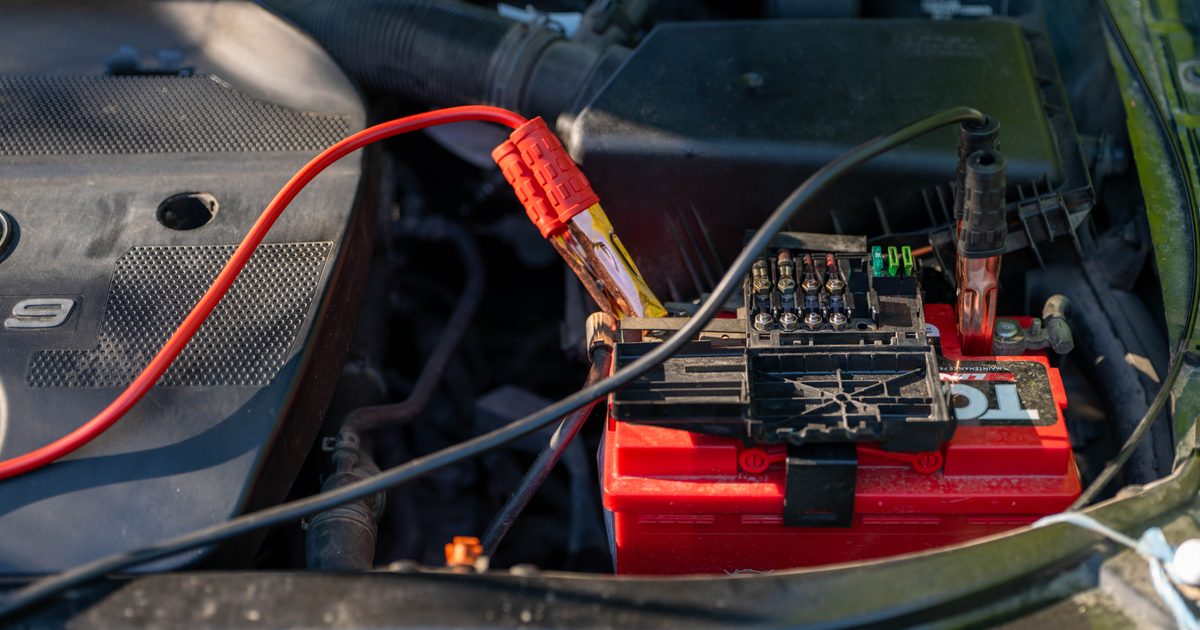
- Try a jump-start first
Connect jumper cables or a jump box to a good battery or donor car. If the engine cranks and starts, the fault is the battery, the cables, or the charging system — not the starter. If it still only clicks with a known-good jump, suspect the starter, solenoid, or a major cable/ground fault.
- Inspect, clean, and tighten the battery terminals
Turn off the ignition, disconnect the negative then positive clamp, and scrub the posts and inside of each clamp with a battery terminal brush until shiny. Check for a burnt, swollen, or green-corroded cable end, retighten firmly, and coat with dielectric grease. A loose or dirty connection is the single most common reason lights work but the starter won't.
- Load-test the battery
With a multimeter, a healthy resting battery reads about 12.4–12.6 V. Have a helper try to crank while you watch the meter: if voltage sags below about 9.6 V, the battery is too weak and should be charged and load-tested (most auto parts stores test for free). A battery that reads fine at rest but collapses under load is failing.
- Test the alternator's charging output
Once the car is running (after a jump), measure battery voltage across the posts with the engine on. A healthy alternator holds roughly 13.8–14.4 V. If it stays near 12 V or lower, the alternator or its wiring isn't charging, which is why the battery went dead in the first place.
- Check the starter and its single click
If you get one firm click and no cranking with a good battery and clean cables, the starter solenoid is engaging but the motor isn't turning. Locate the starter (follow the positive cable to the bellhousing) and gently tap its body with a wrench while a helper cranks — a temporary response confirms an internal starter fault and it should be replaced.
When to call a mechanic
- The battery and terminals test good but the engine still only clicks, indicating a starter, solenoid, or ignition-switch problem
- The starter is buried behind intake manifolds or other components and isn't accessible without lifting the vehicle
- A jump-start gets the car running but it stalls or dies again quickly, pointing to a charging-system or alternator fault
- You find a burnt, melted, or swollen battery cable or main fuse link that needs proper repair, not just cleaning
Frequently asked questions
My lights come on but the car won't crank — what does that mean?
It means the battery still has enough charge to power low-draw accessories but not enough cold cranking amps to spin the starter, or that a loose/corroded terminal is choking the high current the starter needs. Rapid clicking is the classic sign of a weak battery; a single click usually points to the starter.
If the lights work, can the battery still be the problem?
Yes. Lights and the radio draw only a few amps, while a starter can demand several hundred amps. A battery can read roughly 12 V and run the lights yet collapse to under 9.6 V the moment the starter loads it. A load test — free at most auto parts stores — confirms whether the battery is the issue.
The car starts with a jump but dies right after — what's wrong?
That's a charging-system problem, almost always a failing alternator. The jump gives the battery enough to crank, but once the donor cables come off the battery isn't being recharged and the engine dies. Test alternator output with the engine running; it should hold about 13.8–14.4 V across the battery posts.
How much does it cost to fix a car that clicks but won't start?
Cleaning and tightening the terminals is free. A replacement battery typically runs about $100–$250, an alternator $300–$600 installed, and a starter motor $300–$600 installed. Diagnosing with a jump-start and a free parts-store load test first keeps the bill to the actual failed part.
What's the difference between rapid clicking and a single click?
Rapid, repeated clicking means the starter solenoid is rapidly engaging and releasing because the battery can't sustain enough voltage under load — usually a weak battery or bad terminal/ground connection. A single solid "clunk" with no cranking means the solenoid engaged once but the starter motor can't turn, which points to the starter itself.