Quick answer
A loud metal-on-metal grinding when you brake almost always means the friction material is gone and the steel backing plate of the pad is now cutting into the rotor. That hard contact destroys the rotor within a few miles of driving and sharply increases your stopping distance, so it should be treated as urgent. If the grinding also happens while driving or turning and not just braking, suspect a worn wheel bearing or suspension component instead of the pads. Replacement typically runs about $150 to $300 per axle for pads alone, or $350 to $700 per axle if the rotors are damaged and must be replaced too.
Common causes
- Worn-out brake pads worn past the wear indicators down to the metal backing plate, which now scrapes directly on the rotor — the most common cause
- Cheap or low-quality friction material that has glazed, cracked, or chunked apart early, exposing the backing plate before its expected life
- A stone, gravel, or road debris wedged between the pad and the rotor or caught in the caliper, producing a sharp scrape even with good pads
- Rust buildup on the rotor surface after the vehicle sat unused for weeks, especially in humid or coastal weather, leaving a rough crust that grinds until worn clean
- Glazed or hardened pads — from heavy braking or cheap material — that have lost friction and now rub instead of grip
- A seized or frozen caliper that keeps the pad pressed against the rotor so it drags continuously, overheats, and grinds
- Lack of grease on the caliper slide pins so the caliper cannot release fully and one pad wears out far faster than the rest
- A worn wheel bearing that growls or grinds while turning or at speed, not only when braking — often misdiagnosed as a brake problem
How to diagnose and fix it
- Determine when the grinding happens
Note whether the noise appears only when the brake pedal is pressed, or also while driving and turning. Grinding only under braking points to the pads and rotors; a constant or turning-related grind points to a wheel bearing or suspension part.
- Check brake pad thickness
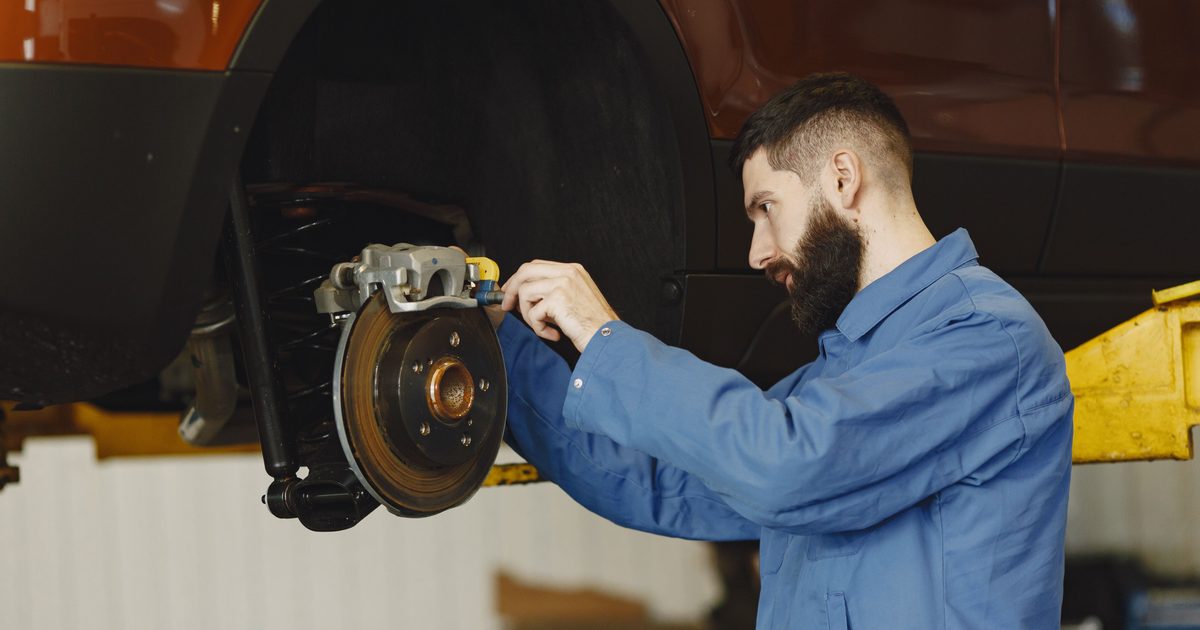
Remove the wheel and inspect the pads through the caliper or with them out. Pads below about 3 mm (1/8 inch) of friction material are overdue, and any pad showing bare steel against the rotor is the source of the grind.
- Inspect the rotor surface
Look for deep concentric grooves, a raised outer lip on the edge, blue heat discoloration, or heavy rust. Light scoring can be machined smooth, but deep grooves or a large lip mean the rotor must be replaced.
- Look for trapped debris and a dragging caliper
Check the gap between each pad and the rotor for a lodged pebble or debris and remove it. Then confirm the caliper slides freely and releases the pad when the pedal is let off — a stuck or overheated caliper will wear one pad to nothing.
- Replace pads and service the hardware
Fit new pads, lubricate the caliper slide pins with high-temperature silicone grease, replace worn clips and shims, and bed the new pads in with a few moderate stops from speed. If one caliper is seized or leaking, replace it and add roughly $130 to $250 per corner.
When to see a mechanic
- The grinding is loud and constant or the brake pedal feels soft, sinks, or pulls to one side
- A seized, leaking, or badly overheated caliper is involved, which requires bleeding the brake fluid
- Deep rotor grooves, a large raised lip, or heat damage mean machining is not enough and the rotors must be replaced
- The noise persists after new pads and rotors are installed, pointing to a wheel bearing, CV joint, or suspension issue
Frequently asked questions
How long can you drive with grinding brakes?
You should not drive at all. Once pads grind on the rotor metal-to-metal, the rotor is scored deeper every mile and can be destroyed within a few miles, turning a pad job into a full pad-and-rotor replacement. Limp slowly to the nearest shop or have the car towed.
Why does my car grind when braking but the pads are good?
Good pads still grind when a stone or road debris is caught between the pad and rotor, when the rotor is heavily rusted after sitting, or when a caliper is seized and dragging the pad. A worn wheel bearing can also grind under braking, especially while turning, even though the pads are fine.
Do I need to replace the rotors if my brakes are grinding?
Often yes. Metal-on-metal grinding scores deep grooves and raises a lip on the rotor that cannot be machined smooth. If the grooves are shallow the rotor may be resurfaced, but deep scoring, a large lip, or heat warping mean replacement.
How much does it cost to fix grinding brakes?
Replacing the pads runs about $150 to $300 per axle. If the rotors are damaged and need replacement too, expect $350 to $700 per axle, and a seized caliper adds roughly $130 to $250 per corner including labor.
Can rust on the rotors cause a grinding noise?
Yes. When a car sits unused for weeks, especially in humid weather, rust forms on the rotor surface and grinds until the pads wear it clean after a few stops. If the grinding does not go away after light braking, the rust has pitted the rotor and it may need resurfacing or replacement.